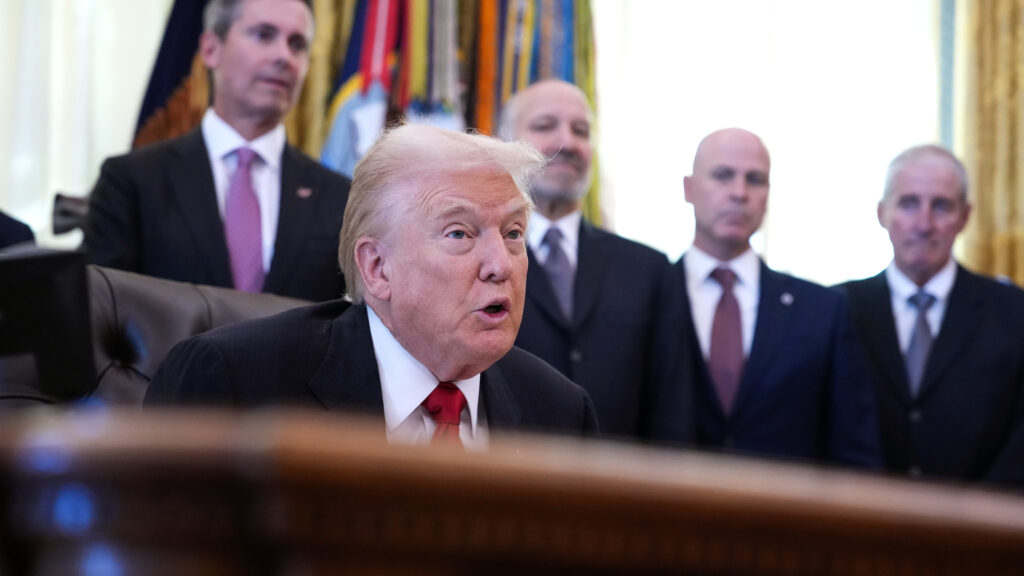
Trump Administration Joins Medicare Drug Negotiations
WASHINGTON — The Trump administration on Tuesday celebrated drug price reductions it achieved through a program created by Democrats — despite Republicans’ long-standing antipathy toward the policy.
The Inflation Reduction Act, a 2022 law supported only by Democrats and signed into law by then-President Biden, allowed the Trump administration to obtain lower prices on 15 drugs for Medicare beneficiaries, including popular GLP-1s like Wegovy and Ozempic.
Centers for Medicare and Medicaid Services Director Mehmet Oz boasted that the latest round of negotiations resulted in even bigger price cuts than those achieved by the Biden administration last year, when officials set prices for 10 drugs. Oz said the Trump administration used “the same process with bolder leadership,” adding that the Biden administration’s negotiations were “modest” in comparison.
“Whether it’s the Inflation Reduction Act or President Trump’s Most Favored Nation policy, this is what serious, fair and disciplined negotiations look like,” Chris Klomp, CMS deputy administrator and Medicare director, said in a statement about the negotiations.
The Trump administration’s approval of the law is a far cry from how Republicans previously talked about the negotiations made possible by the 2022 law. Republican lawmakers had suggested that drug negotiations would prevent life-saving drugs from reaching patients who need them and even “destroy new cures before they reach the market.”
In 2023, Sen. Mike Crapo (Idaho) said the drug negotiation provisions of the law “ignore economic realities,” and Sen. Bill Cassidy (La.) denounced the negotiations as “partisan price control.” Rep. Jason Smith (Mo.), chairman of the House Ways and Means Committee, previously said the law “radically dismantles the promise of Medicare to America’s seniors.”
But on Tuesday, the Trump administration said the negotiations would bring “significant relief to millions of Americans.”
This marked shift suggests that there are some areas of new bipartisan agreement on health policy, despite an administration that has pushed an aggressive reform agenda that has shaken up the American health care establishment. It also shows that Trump himself could craft a new health care agenda for his party, focused in part on tighter government controls on drug prices.
“It’s getting really difficult now – which we are happy about and patients should be happy with – for the [Republican] “If the Republican Party decides to undermine this law, it will do so at its own political risk.”
Trump’s push to the center on health care issues goes beyond reliance on the IRA. Earlier this week, the White House considered a proposal that, with some new restrictions, would extend Affordable Care Act subsidies — just weeks after Republicans rejected Democrats’ demands on the issue, leading to the longest government shutdown in history.
And the president has pushed aggressive price cuts for drug companies, repeatedly threatening to use a host of federal powers, from drug approval processes to 100% tariffs, to lower prices if companies don’t volunteer to do it themselves. Through this approach, the administration has achieved prices that, for some drugs, are lower than those set by the IRA (and should be used in place of law-based negotiations) – although voluntary agreements can be broken at any time.
Trump’s approach to health care — at odds with his party’s laissez-faire philosophy — could not only reshape Republicans’ health care agenda, but also make new government action politically viable in Washington.
“These days, it is unfortunately rare to see this,” Anand Parekh, health policy manager at the University of Michigan School of Public Health, said in an email regarding the current administration’s IRA negotiations. “These negotiations are generally good financially for taxpayers and beneficiaries, and we hope that we will achieve better health outcomes as a result. »
New approaches, new questions
It is unclear why the reductions achieved through the IRA negotiations were greater under Trump than under Biden – and whether prior confidential agreements may have influenced the negotiations in any way.
The Biden administration negotiated prices that would have saved Medicare about 22% on the cost of the 10 drugs then under discussion. The Trump administration, which negotiated 15 drugs — including expensive and in-demand semaglutide — estimated a 36 percent reduction.
The price of IRA is set based on complex calculations and myriad factors in the pharmaceutical market, and different drugs are selected for each cycle.
“I think this reflects, in part, a longer list of drugs that were selected for the second round of negotiations and that included several cancer drugs that probably had relatively small discounts to begin with,” Juliette Cubanski, deputy director of the Medicare Policy Program at health policy research firm KFF, said of the larger discounts in the second round of negotiations. “So that would give the government a lot more room to negotiate lower prices, because the starting point was probably a lot higher than the ceiling that they had to hit as a minimum.”
Basey also said the average reductions per drug were “nearly identical” to those in the first round of negotiations.
The savings come as the Trump administration has pushed drugmakers to offer lower prices, threatening more aggressive — and less predictable — action against the industry than the Biden administration.
These threats led to a series of secret deals in which drugmakers agreed to lower their prices and, in exchange, get price reductions and preferential treatment for drug approvals.
But it remains unclear how these agreements may have influenced the IRA negotiations or will co-exist with them.
For example, under an earlier agreement with the administration, the makers of GLP-1 agreed to sell certain versions of the drug — Ozempic, Wegovy, Mounjaro and Zepbound — to Medicare for $245 a month. In exchange, federal officials agreed to expand Medicare drug coverage.
Negotiations based on the IRA set the price at $276.78 per month for the commonly used doses of Ozempic and Rybelsus, and $385.63 per month for the highest dose of Wegovy.
“Due to the terms and timelines of the negotiated agreements, MFN prices for covered GLP-1 drugs are expected to supersede IRA prices,” a CMS spokesperson said in a statement.
A Novo Nordisk spokesperson added in a statement that the company is “looking[s] We look forward to additional clarification from CMS on how pricing and coverage will work together to support patient access as details are finalized.
An Eli Lilly spokesperson made clear that the company preferred the voluntary agreement reached under Trump over negotiations with the IRA required by law, saying the latter was “not a negotiation but a process of government pricing that does nothing to increase affordability for seniors while hindering innovation.”
Spokespeople for Novo Nordisk and Eli Lilly did not respond to questions about why the semaglutide prices set by the IRA were different from those announced in the previous agreement with Trump, how long the companies planned to maintain their voluntarily reduced prices, or whether the IRA’s negotiations were involved in the earlier confidential agreements with the administration.
Drug pricing experts and patient advocates worry that the sometimes deeper cuts resulting from Trump’s deals won’t last.
“I don’t know to what extent [MFN] “It is,” said Sean Sullivan, a professor at the University of Washington who researches health economics, emphasizing that the IRA is more concrete because it is a law. “If they were serious about MFN, they would write it into law, instead of one-off press releases.”
Trump, despite being the most powerful person in the Republican Party, continues to face resistance from his own party on some of his health care ideas. Initial White House proposals to include sweeping drug pricing proposals in the Republicans’ reconciliation plan earlier this year were quickly rejected by Republican lawmakers. And some congressional Republicans have been skeptical of Trump’s latest ACA subsidy proposal.
In the meantime, Democrats are happy to take credit where they can — especially after seeing the success of their campaign to make health care more affordable.
“Democrats took on Big Pharma by giving Medicare the power to negotiate on behalf of tens of millions of seniors who want lower drug prices, while every Republican voted against it,” Sen. Ron Wyden (D-Ore.) said Tuesday. “Today’s announcement is the result of Democratic efforts to reduce health care costs for older Americans.”
Elaine Chen contributed reporting.
Firm Law
Agen Togel Terpercaya
Bandar Togel
Sabung Ayam Online
Berita Terkini
Artikel Terbaru
Berita Terbaru
Penerbangan
Berita Politik
Berita Politik
Software
Software Download
Download Aplikasi
Berita Terkini
News
Jasa PBN
Jasa Artikel