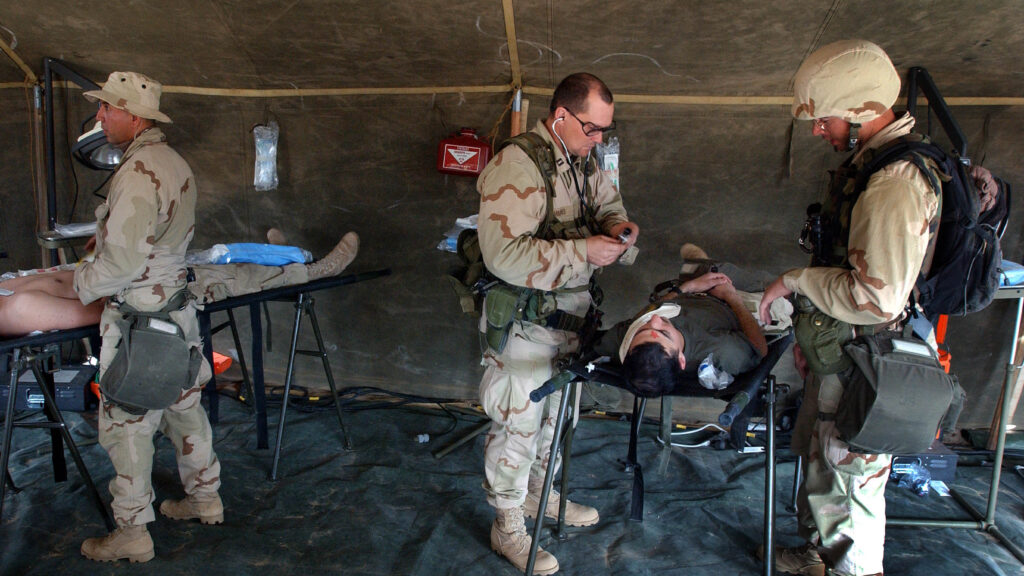
America’s military medical corps needs a new approach to recruiting
The war in Iran has produced what years of policy documents could not. It forced an honest reckoning about America’s military preparedness. While commentators focus on vulnerabilities in industrial capacity and weapons supply, they consistently overlook a critical dimension of preparedness: the uniformed medical and technical personnel who make sustained military operations possible.
Across the tri-service medical corps, encompassing the Army, Navy and Air Force, recruitment rates have historically struggled to keep pace with separations. A 2024 study from the RAND Corporation found that a larger-than-expected proportion of physicians leave after fulfilling their service obligations, citing salary disparities, administrative burden and declining clinical skills as primary factors.
The pay gap is the most frequently cited factor and the most difficult to resolve. A 2020 Government Accountability Office study found that military doctors in two-thirds of specialties can’t even reach the 20th percentile of civilian pay. Although exact numbers fluctuate, the gap between military and civilian earnings for procedural specialists can exceed $400,000 per year.
Additionally, clinical skills are deteriorating in garrison hospitals. A Department of Defense Inspector General report released in June 2025 found that emergency physicians in critical wartime specialties were assigned to locations without direct patient care, thereby degrading their clinical skills below readiness standards.
The medical profession is made up of physicians, most of whom fall under the Health Professions Scholarship Program. Under this program, the Navy funds medical school and provides a stipend in exchange for active duty, typically one year for each scholarship year with a minimum of three years. Others train at the Uniformed Military University of Health Sciences, which carries a seven-year obligation, and fully trained civilian doctors can join directly.
Regardless of the path chosen, each officer is subject to a total military service obligation of eight years. Any time not spent on active duty is served in reserve status, often with the individual reserve ready, meaning the medic does not train but remains subject to recall.
I entered the Navy Medical Corps in 1973 through the draft and served for over 25 years, eventually serving as an attending physician to the U.S. Congress. After my military retirement, I acquired privileges at a teaching hospital and eventually achieved clinical professor status, an appointment motivated in large part by the fact that civilian academic institutions place a high value on the unique leadership, discipline, and clinical experience forged during military service.
During this dual career, I have seen the military health system operate as one of the most effective training and care delivery platforms in the world. This system is now hemorrhaging talent, and the pipeline to replace it is shrinking on both sides. With the Association of American Medical Colleges projecting a physician shortage of up to 86,000 by 2036, the military is competing with the civilian sector for a shrinking talent pool.
Consider the supply side. The Uniformed Services University trains only a fraction of the doctors the military needs. The vast majority must be recruited from the approximately 180,000 students and residents in civilian programs. Among this group, a small but significant number are already medically ineligible under current Department of Defense membership standards. In my experience, many others are not interested due to significant discomfort with institutional policies they perceive as exclusionary. Medical school courses today are more diverse than at any time in history. Women now make up about half of all enrollment, and the student body reflects the entire demographic breadth of the country. When a substantial fraction of this talent pool refuses to even consider military service, no amount of signing bonus will close the gap.
To preserve our military medical tradition, structural reforms are necessary. The military has used lateral entry in theory and partially in practice, but existing pathways do not reflect current economic and clinical realities.
The era of the independent doctor, like that of the independent practitioner who would have had to close his practice to carry out his duties, is largely over. In 2022, less than half of American doctors owned their practices. Relevant negotiating partners today are academic health systems and privately funded recruitment groups that increasingly employ specialists within regional networks. These entities have the depth to absorb periodic physician absences and the corporate infrastructure to manage the arrangement.
What they currently lack is incentive. Congress could create one through a three-way structured arrangement.
First, Congress should create a Medical Readiness Partnership Tax Credit available to any organization that employs a physician for military service. For purposes of illustration, this amount could be set at a rough figure of $1,500 to $2,000 per day of military service. This transforms military service from a calendar liability into a financial asset.
For academic health systems, this model offers profound institutional advantages. In addition to turning a scheduled absence into a financial asset via tax credits, these academic centers have an elite cadre of proven trauma and emergency specialists. Additionally, as today’s postgraduate students are increasingly hungry for meaningful public service, teaching hospitals that enthusiastically support military reserve functions will have a unique and highly attractive recruiting tool for top medical talent.
Second, we must pair employer incentives with flexible and meaningful benefits for every physician. This is expected to include financial benefits, such as an exclusion from gross income for military reserve pay during periods of service and the reinstatement of the above-the-line deduction for unreimbursed military expenses, eliminated in 2017.
It is crucial that the military balances these finances with attractive incentives such as robust family health care coverage, reductions in the cost of prescription drugs, and partial retirement opportunities for those who provide vital service before a full 20-year career.
Third, the bureaucratic burden of obtaining military medical degrees is a significant deterrent. A standardized “green card” accreditation process recognizing civil board certification and hospital privileges as a benchmark would eliminate months of friction. We already know that this clinical model works. Tri-Service integration programs, such as Civilian Military Trauma Team Training and Navy Integration, have demonstrated that Level I civilian trauma center physicians accrue readiness points at rates five to ten times higher than their military hospital counterparts. These partnerships provide a powerful synergy: civilian hospitals benefit enormously from having highly disciplined, combat-trained specialists to manage their most critical trauma cases, while the military successfully maintains a highly advanced, deployment-ready medical force. All that remains is to build the financial and regulatory architecture to make it scalable.
The military also needs to communicate its successes and benefits more effectively. Military medicine’s contributions to vaccine development, trauma surgery, infectious disease research, and disaster response constitute one of the most undertold stories in American public health. Clinicians drawn to the intersection of science and national security need to hear it.
Finally, my regular conversations with medical students, postgraduate trainees, and even more senior clinicians suggest that they are often hungry for meaningful public service. They seek relevant work at the intersection of medicine and the public good, and they often welcome the variation in routine that temporary active duty assignments might bring. They need the best possible opportunity to achieve this.
Robert Krasner is a retired US Navy Medical Corps Rear Admiral, retired professor of medicine, and former attending physician to Congress.
PakarPBN
A Private Blog Network (PBN) is a collection of websites that are controlled by a single individual or organization and used primarily to build backlinks to a “money site” in order to influence its ranking in search engines such as Google. The core idea behind a PBN is based on the importance of backlinks in Google’s ranking algorithm. Since Google views backlinks as signals of authority and trust, some website owners attempt to artificially create these signals through a controlled network of sites.
In a typical PBN setup, the owner acquires expired or aged domains that already have existing authority, backlinks, and history. These domains are rebuilt with new content and hosted separately, often using different IP addresses, hosting providers, themes, and ownership details to make them appear unrelated. Within the content published on these sites, links are strategically placed that point to the main website the owner wants to rank higher. By doing this, the owner attempts to pass link equity (also known as “link juice”) from the PBN sites to the target website.
The purpose of a PBN is to give the impression that the target website is naturally earning links from multiple independent sources. If done effectively, this can temporarily improve keyword rankings, increase organic visibility, and drive more traffic from search results.

Related Posts

From donor eggs to shorter wait times, could India offer a different path to parenthood? Here’s what two doctors want you to know

New clues emerge in direction of RFK Jr.’s vaccine policy changes