Missed first shots linked to parents then skipping measles shots
Babies who don’t get their first round of vaccines on time, at 2 months of age, are much less likely to be vaccinated against measles, mumps and rubella by age 2, according to a new study that suggests pediatricians may have a narrow window to persuade parents to follow the recommended immunization schedule for children.
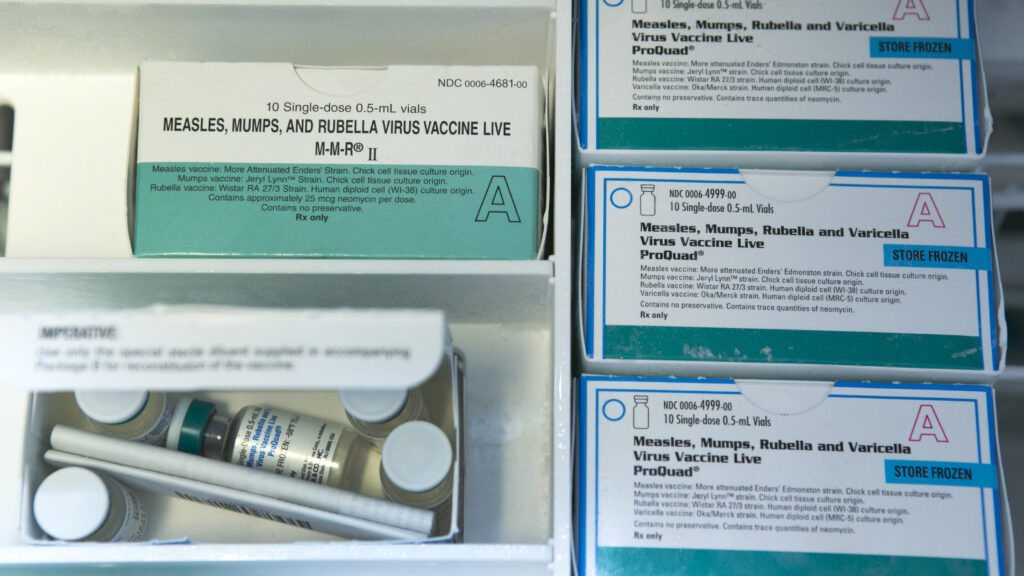
The study, published Friday in JAMA Network Open, reports that in the post-Covid-19 pandemic period, babies who did not receive their vaccine on time at 2 months of age — the age at which the Centers for Disease Control and Prevention recommends babies get vaccinated against a host of diseases — were more than seven times more likely to not receive their first measles, mumps, and rubella (MMR) vaccine by age 2, or months later than when this vaccine is supposed to be administered. Babies are supposed to receive their first MMR injection between 12 and 15 months, and a second between 4 and 6 years.
“This study shows that very early vaccination delays lead to later vaccination delays or even missed measles vaccinations,” said Nina Masters, an epidemiologist and lead author of the paper. “This shows that hesitation starts very early and extends over a long period of time.”
“And while we’re looking at a really bad year for measles, it’s really important that we do everything we can to try to increase measles vaccination coverage.”
The CDC reported this week that as of December 30, the United States had recorded 2,065 confirmed cases of measles in 2025, the highest number in a single year in more than three decades. There are concerns that some of the current cases are linked to an outbreak first detected in West Texas last January — a fact that, if confirmed, would put the country on track to lose its measles elimination status early this year.
The study is based on electronic health record data maintained by Truveta, a healthcare data analytics company owned and governed by 30 health systems. Truveta’s data pool contains health care utilization information for about 120 million people, or about a third of the country.
Masters is a senior applied research scientist at Truveta. She and her co-authors studied de-identified health data from approximately 322,000 children born between 2017 and 2023 who received regular care from a Truveta network health system, examining vaccination patterns during their first two years of life.
The finding that children whose first injections are delayed are likely to receive subsequent injections later than recommended – or not at all – is not new; previous studies have also shown this.
“Having received a vaccine in the past is a good predictor of future vaccination,” said Noel Brewer, a professor of health behavior at the University of North Carolina. Brewer was a member of the CDC’s vaccine advisory committee until Health Secretary Robert F. Kennedy Jr. fired the entire committee last June and appointed in their place people who shared his vaccine skepticism.
But the period studied in the paper was from 2018 to 2024, which allowed the researchers to look for changes that might have occurred after the start of the Covid-19 pandemic. Falling vaccination rates since the pandemic have been associated with increased distrust of public health authorities and increased resentment of Covid containment measures.
Over the total period, 78.4% of children received their first MMR injection on time, 13.9% received it late, 1% received it early and 6.7% did not receive it at the age of 2 years.
But researchers did see a drop in the rate of children who received their first dose of the MMR vaccine on time. It decreased by three percentage points between 2021 and 2024, Masters noted. “That’s a pretty significant drop in three years.”
Notably, the percentage of children who received the MMR vaccine late remained relatively constant during the study period. What changed was the percentage of children who had not received a first dose of MMR by age 2. This figure increased from 5.3% in 2020 to 7.7% in 2024. “It’s not that more people were delaying, but rather that more people were not getting the MMR vaccine. [for their babies] at all within 2 years,” she said.
The main indicator of whether children would receive their first dose of the MMR vaccine on time came very early in the vaccination process: whether babies received the recommended vaccines on time at 2 months of age.
Vaccination against multiple pathogens begins with a visit to the pediatrician at 2 months of age, when the CDC recommends that babies be vaccinated against hepatitis B, rotavirus, diphtheria, tetanus, pertussis, polio, Haemophilus influenzae type b, and pneumococcal disease. (This does not involve eight separate inoculations; when possible, pediatricians use multivalent vaccines that protect against five or six of these diseases in a single injection.)
Masters said the findings suggest pediatricians should start talking with parents about the importance of getting vaccinated — and vaccinating on time — before the 2-month appointment.
“The three biggest influences on vaccination are prior receipt of the vaccine, intention to vaccinate and a doctor’s recommendation,” said Brewer, who was not involved in the study. “The most promising avenue of intervention is a doctor’s recommendation.”
The American Academy of Pediatrics recommends frequent contact between pediatricians and babies early in children’s lives. These visits take place during the first week, at 1 month and 2 months, and then again at 4 months, 6 months and 9 months.
Studies show that the best way to persuade parents to vaccinate their children is to have them receive a recommendation from a trusted doctor. But with multiple injections scheduled for the two-month visit, pediatricians don’t have much time to build trust with a new patient’s parents, Masters said.
“So that creates a window of opportunity that is quite short and puts, I think, the responsibility on these pediatricians to really talk about vaccines as early as possible, to build trust as early as possible, to build education. [and] familiarity from the start. Don’t wait for that 2-month visit, when the parent might refuse or delay, but do it right away,” she said.
Added to this challenge is the fact that many babies do not see pediatricians according to the recommended schedule. The study found that within the cohort studied, just under half of the babies saw their medical providers according to the AAP schedule. And these were babies benefiting from a medical home, notes the study. They had a pediatrician. Their parents had health insurance. The numbers are likely even lower, Masters says, among children whose parents lack insurance or who have failed to register with a pediatric practice.
“I think it’s conservative,” she said of the results. “I think if we had a way to look at parents who aren’t bringing their kids, who aren’t getting their kids immunized, who don’t have a medical center — which we don’t have the capacity to do — we would probably see lower coverage, lower timeliness and, in general, lower opportunities for intervention to get kids back on track once they’re off schedule.”
Brewer said most children receive some vaccines, but parents’ willingness to deviate from the recommended schedule for certain shots is usually a sign of things to come.
“People who skip one vaccine are more likely to skip other vaccines,” he said. “Only about 2% of people will ever get vaccines. So most people get most vaccines. But those who don’t get some vaccines are also less likely to get others.”
Masters noted that the document does not account for the impact of changes to vaccination policy that have occurred since Kennedy — a longtime proponent of disproven vaccine safety claims — was named the nation’s top health official.
Among those changes: a decision in early December by the CDC’s vaccine advisory committee to abandon a more than 30-year-old recommendation that all babies be offered hepatitis B vaccination within 24 hours of birth. It now recommends vaccination at birth only for babies whose mothers tested positive for hepatitis B during pregnancy or whose test status is unknown. Other babies should start hepatitis B vaccinations — if their parents want them — at 2 months of age, the CDC now recommends.
Masters said she and her colleagues plan to examine the implications of changes to the hepatitis B vaccine.
Berita Terkini
Berita Terbaru
Daftar Terbaru
News
Berita Terbaru
Flash News
RuangJP
Pemilu
Berita Terkini
Prediksi Bola
Technology
Otomotif
Berita Terbaru
Teknologi
Berita terkini
Berita Pemilu
Berita Teknologi
Hiburan
master Slote
Berita Terkini
Pendidikan
Resep
Jasa Backlink
Togel Deposit Pulsa
Daftar Judi Slot Online Terpercaya
Slot yang lagi gacor