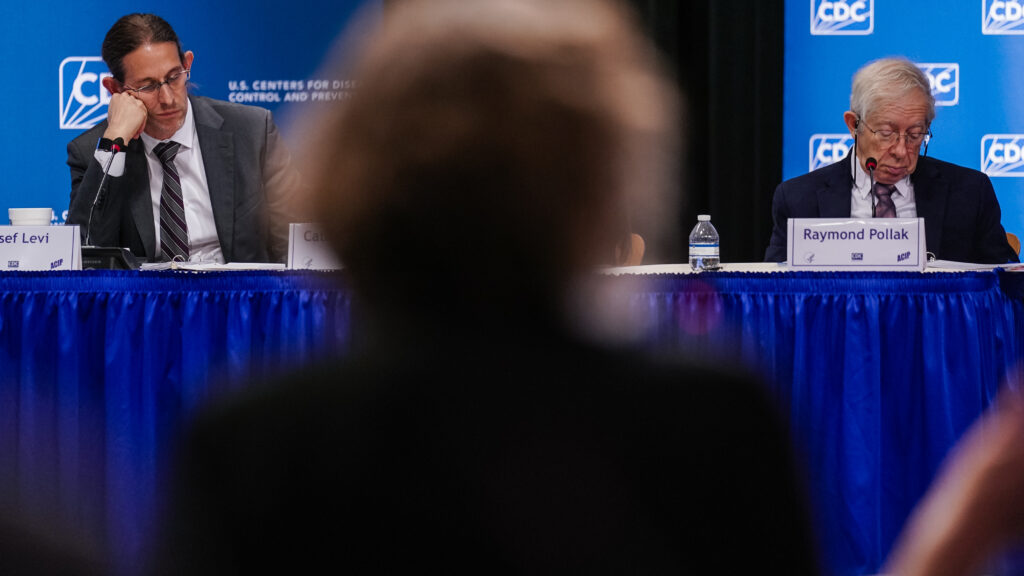
Childhood vaccines under scrutiny from Kennedy’s ACIP panel
WASHINGTON — Federal vaccine advisers, in a freewheeling and sometimes combative two-day meeting, recommended a major change in childhood immunizations that flies in the face of medical consensus — and began laying the groundwork for a broader overhaul in the future.
New recommendations and many arguments about U.S. vaccination strategies overlook vast amounts of data that show vaccines are safe and effective, infectious disease and public health experts said, while embracing unsubstantiated notions that vaccinations could pose hidden dangers. The committee’s new approach could harm America’s children, medical groups said.
“This is a significant departure from the historic role that ACIP has played in shaping vaccine policy in the United States,” said a joint statement from dozens of groups representing physicians and public health interests. “Previously, we could expect that science would guide decisions, that experts would debate the evidence, and that consensus would result in shared, clear recommendations. That is not the case with the current committee, and this change puts the health of Americans at risk.”
The Advisory Committee on Immunization Practices voted Friday to withdraw a decades-old recommendation that every baby receive a hepatitis B vaccine at birth. Troubling medical experts, the group made the decision despite no new data showing the injections are dangerous or don’t work.
In fact, hepatitis B vaccines have been shown to be safe in more than a dozen randomized controlled trials, according to Evidence Collective, a group of health experts. Four of these studies directly compared the birth dose to a delayed first dose, as recommended by the committee, and found no increased risk of short- or long-term adverse events for the birth dose.
The ACIP is now looking to review more vaccines for children, although it has not specified which ones. The ACIP formed a task force to review the childhood immunization schedule, including the suspected risks of administering multiple shots at once. (Experts have long said the current schedule is safe.) The committee is expected to meet again in February.
Several committee members, even before finishing the vote on hepatitis B, suggested that their review of this vaccine could offer a road map for thinking about other vaccines on the schedule.
These members, including Retsef Levi and committee vice chair Robert Malone, based their arguments on the assertion that the risk of vaccinating a newborn against hepatitis B might outweigh the benefits, due to their young age and underdeveloped brain.
“As a parent, we encourage you, in consultation with your doctor, to think very carefully: do you want to expose your baby to a procedure that could have harmful consequences when the risk [of hepatitis B] is so low? » said Levi.
ACIP begins discussing childhood immunization schedule
Malone went further. He said there may be unknown risks to giving multiple shots at the same time during infancy.
“My view is that this topic has merit,” Malone said. “This is why we now have a working group on the childhood vaccination schedule.”
Tracy Beth Høeg, a senior Food and Drug Administration official who liaises with ACIP, questioned whether babies born to mothers who test negative for hepatitis B should be vaccinated against the virus.
Once the group completed its work on hepatitis B vaccination, it moved on to discussions about the childhood vaccination schedule in general.
The first person to present was Aaron Siri, a vaccine critic and attorney who represents people making vaccine injury claims. Siri, who has become one of the leading voices in the anti-vaccine movement, gave a radical presentation in which he worked to undermine confidence in the current childhood vaccination schedule.
Levi called on the group to explore the “underlying biological mechanisms that occur when we vaccinate children with one vaccine, with multiple vaccines, and how timing and genetics impact that.”
The argument that multiple vaccines administered in a relatively short period of time could pose new risks, repeated by anti-vaccine activists for years, could have implications for the series of shots that protect children against a host of dangerous diseases, from polio to diphtheria.
Even President Trump, speaking from the White House in September, urged parents not to vaccinate their children until they are older. And following similar logic, he called for the combined vaccination against measles, mumps and rubella to be separated.
It’s no surprise that ACIP members scrutinize tried-and-true clichés closely. Earlier this year, Health Secretary Robert F. Kennedy Jr. overhauled the ACIP, firing all existing members and adding new members, many of whom criticized traditional vaccine guidelines. Kennedy’s HHS has also hired a number of people who have long questioned vaccines into positions within the department, including at the Centers for Disease Control and Prevention.
Yet two ACIP members, Cody Meissner and Joseph Hibbeln, tried to stop the panel from extrapolating that the potential, unknown risks of vaccines given to children outweigh their benefits. During a discussion about aluminum in vaccines, Meissner, a pediatrician, urged the committee not to get distracted by settled debates, including whether vaccines cause autism, which has been completely debunked. Aluminum, used to enhance the effects of vaccines, has also been widely studied.
“I don’t think having ACIP and CDC spending more time on the aluminum issue is very productive,” he said.
Infectious disease experts were alarmed by the committee’s focus on the broader childhood timeline — especially after the committee was willing to change its recommendations on hepatitis B vaccines without evidence, they said.
“No one should follow the ACIP recommendations,” Peter Hotez, an infectious disease expert and vaccine developer at Baylor College of Medicine in Houston, said Thursday. Hotez was invited to appear before the committee but declined, saying he thought it was wrong to legitimize the process by participating.
The commission voted Friday to recommend delaying the first dose of the hepatitis B vaccine from birth for children whose mothers have tested negative for the virus. The group also voted to recommend that vaccinated babies have blood tests to see if they need booster shots — despite a lack of understanding about whether a single dose would actually provide lasting protection.
The committee’s vote recommending delaying vaccination is unlikely to change doctors’ and hospitals’ practice of recommending it at birth, three doctors told STAT. But they expect the meetings to further erode confidence in vaccines — and if the committee moves forward with reviewing other vaccines as it did for hepatitis B, that erosion is likely to deepen, they said.
Hibbeln appeared disturbed by the votes that took place – and what they could mean for future recommendations.
“This has great potential for harm,” Hibbeln said Friday, as he voted against changing the hepatitis B recommendations. “I just hope the committee accepts responsibility when harm is done.”
“Roger that,” Malone replied, before moving on to the next item on the agenda.
Aluminum in vaccines under scrutiny
The committee took particular interest in vaccines containing aluminum adjuvants, with group members saying they should investigate the ingredient – used in many vaccines – for its association with a number of adverse events.
This will likely be key to the committee’s future work: Kirk Milhoan, the committee’s chair, said the group should “ask important questions” about a possible link between aluminum and adverse events, even though mainstream researchers have found that aluminum is safe and plays an important role in vaccinations globally.
Government pressure to remove aluminum could reduce access to several shots that have long been central to the childhood immunization schedule. Ordering the removal of aluminum from vaccines could be one of the most effective steps the administration has ever taken, experts and vaccine maker employees have previously told STAT — although the impact depends on how aggressive officials are on the issue.
The aluminum adjuvants targeted by the committee are used in many vaccines to boost their effectiveness, essentially allowing fewer antigens to produce a greater immune response (and greater protection against disease).
Experts and vaccine makers have been alarmed that Kennedy and even the president himself have said they want to review or remove aluminum from vaccines. Changing the formulations, they said, would likely take a decade and more than $1 billion for each new vaccine — and that’s unnecessary, given current evidence.
Adjuvants are well-studied, vaccine safety experts said, and almost everyone ingests more aluminum in their food and water than the small amounts in injections. A review of evidence published in the journal Pediatrics also noted that aluminum in vaccines is usually eliminated from the body through the kidneys.
Although some health care providers believe the new recommendations will not change the way most doctors practice medicine, the ACIP meetings are part of a larger messaging campaign that will erode public confidence in vaccines.
“This damage has already happened,” Sean O’Leary, a physician who chairs the American Academy of Pediatric’s infectious diseases committee, told reporters Tuesday before the ACIP meeting. “I think it’s only going to happen more.”
Firm Law
Agen Togel Terpercaya
Bandar Togel
Sabung Ayam Online
Berita Terkini
Artikel Terbaru
Berita Terbaru
Penerbangan
Berita Politik
Berita Politik
Software
Software Download
Download Aplikasi
Berita Terkini
News
Jasa PBN
Jasa Artikel